The Definitive Guide To Growing Your Blog’s Audience 3x Faster

Have you ever felt like your blog’s audience wasn’t growing fast enough?
You’re not alone.
Every blogger has had that feeling.
So what can you do to make it happen?
It all starts with a strategy focused on putting your visitors first and I’m going to show you exactly how.
But, there’s another hurdle to this audience growth thing.
And that is ensuring that those readers keep coming back to your blog in the future.
So in today’s post, you’ll learn everything you need to know in order to grow your audience faster as well as how you can make sure that your readers keep coming back.
Sound good?
Let’s dive in and get started!
Quick links
This post is packed with lots of detail, so to make it easier to navigate, I’ve added quick links which you can use to instantly navigate to a particular section of the post:
How to grow your blog’s audience faster:
- Start networking with other bloggers on a regular basis
- Contribute to the top blog’s in your niche
- Create your own tribe on Triberr and invite other bloggers
- Publish content your target audience wants to read
- Encourage social sharing with these tactics
- Make promotion part of your blogging process (and here’s how to do it)
How to keep your audience coming back for more:
- Tidy up your blog’s user experience
- Encourage your audience to subscribe to your email list
- Ask your audience to join you on social networks
- Make RSS subscription easy (it’s not dead yet)
- Engage with your audience
How to grow your blog’s audience faster
In order to get people on your blog, you need to expand your reach.
This ultimately means driving as much targeted traffic to your blog as possible.
I’ve talked about traffic generation tactics in the past, but which of those tactics can really move the needle and accelerate your blog’s growth?
Below you’ll find some of the tactics that have the potential to grow your audience faster.
1. Start networking with other bloggers on a regular basis
As the saying goes:
“It’s not about what you know, it’s who you know.”
… The same can be said about blogging.
When you start networking, you’ll notice you get more traffic, shares and engagement on your blog.
And once you’ve developed strong relationships with other bloggers, that’s when you can figure out other ways of helping each other.
But, remember – there has to be mutual benefit.
So how can you start getting to know other bloggers in your niche?
- Engage with other bloggers on social networks – This can include sharing other people’s content and responding to them in comments of status updates.
- Leave helpful comments on other blogs – This is best done on personal blogs where the owner responds to comments. This is a sure-fire way to get noticed providing you leave anything promotional out of your comments and focus on leaving helpful comments.
- Become part of a thriving community in your niche – Online communities are a great way to connect with other bloggers. From Sub-Reddit’s to Facebook Groups and forums, there’s plenty to choose from.
2. Contribute to the top blogs in your niche
If you want to grow your audience, contributing guest posts to top blogs in your niche will be extremely effective.
But, in order to get results that will truly move the needle, there is a specific approach you need to take.
Here’s how you should approach guest blogging:
- Identify blogs in your niche with an engaged audience – If you’re contributing to a blog with no following and no engagement, you’re not going to get much in the way of results. Social shares and comments are good benchmarks to look at.
- Connect with the owner of the blog before pitching them – This is essential. We talked about getting to know bloggers earlier; the exact same steps apply here. Get to know the blogger before and it’s more likely that your pitch will be successful.
- Make your pitch about the blogger and how you’ll help them – Most bloggers receive a crazy amount of pitches from guest bloggers. Read this post to find out how to write the perfect email pitch.
- Don’t hold back when it comes to writing content – I can understand that you may want to keep your best content to publish on your own blog, but if you really want to reap the rewards of guest blogging, go all out!
- Build an email list using your guest posts – Just guest blogging on its own will help you create awareness about you and your blog, but you can also build your email list. It’s as straight forward as linking to a page with an opt-in form from your author bio. We’ll talk more about building an email list later in this post.
- Promote your post like you’d promote one on your own blog – The more effectively you promote your guest post, the better. The blogger you’ve written the post for will appreciate it and likely be open to you contributing in the future.
- Respond to comments even if the blog owner doesn’t – Responding to people who leave comments is a great way to get noticed and increase engagement later on.
3. Create your own tribe on Triberr and invite other bloggers
Triberr is a social platform that makes it easy to share each other’s content. It can be a great way to increase your reach, network with other bloggers and grow your audience.
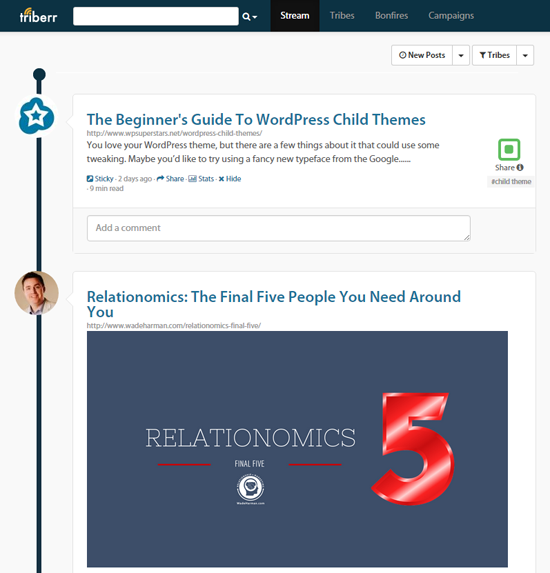
On Triberr, you’ll find tribes of bloggers under a wide variety of topics.
You can apply to join tribes as a follower and in those cases you’ll get updates from that tribe within your “tribal feed” (pictured above).
The chief of a tribe can then promote you to a full member, your blog posts will be seen by everyone else in your tribe, providing you’ve added your RSS feed to your settings page.
One great way to get started on Triberr is to create your own themed tribes – you’ll then be able to find other active bloggers who write about the same topic.
To do this, you’ll need to sign up for an account, click on the “tribes” tab at the top, then click the “new tribe” button.
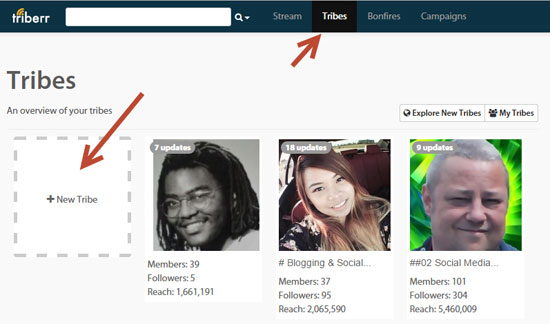
Then you can write a description for your tribe and start searching for bloggers who’d be a good fit for your tribe.
4. Publish content your target audience wants to read
When you publish the right content for your target audience, you’ll grow your readership faster.
And when you publish the right content consistently, those readers will stick around.
Before you can dive into specific steps here, you’ll need to figure out exactly who your target audience is (and how you’re going to help them).
Once you’ve got that figured out, you can use a combination of these tips to narrow down which topics to write about:
- Monitor trends and write newsworthy content – Spotting emerging trends and writing about them is a great way to get visibility and stay on top of what’s happening right now. This post by Ann Smarty covers the process in more detail.
- Monitor important topics with Google Alerts or Talkwalker Alerts – Both of these tools are free and can give you a heads up the next time someone writes about topics you cover on your blog. This can be a great way of spotting trends before they happen and getting an insight into what others write about within your niche.
- Find popular content using BuzzSumo – Which topics are getting the most traction on social networks? And which topics are working well for your competitors? BuzzSumo is a paid tool but you can still get some helpful data for free.
- Use SEMrush to find out what keywords your competitors are ranking for – SEMrush can show you some of the keywords your competitors rank for and give you rough traffic estimations. It’s a paid tool, but you can still get some good data for free.
Whichever topics you cover, keep your audience at the heart of your content and focus on solving their problems.
Headlines also play an important part in this process. This post by Elna Cain covers some tools which can help you come up with headlines and optimize them – just don’t forget the human element.
5. Encourage social sharing with these tactics
When you get more social shares, chances are that you’ll get more traffic.
Chances are that for each new person that shares your content, even more new readers will find their way to your blog.
But, what can you do to encourage people to share your content?
Make it easy to share your content via social networks
Before we can start encouraging social shares, we need to make it easy for people to share.
This is straight forward – add social share buttons to your blog.
I currently use a WordPress plugin called Social Snap for this (it also helps with a tactic I’ll talk about in a moment).
One thing I particularly like about this plugin is that you can add a unique image that will just be used when your content is shared on Pinterest. This is great because taller images work better on Pinterest.
But, there are plenty of other tools and plugins you can use to add share buttons, this post covers some alternatives.
Limit the number of share buttons
I used to add social share buttons for almost every network imaginable.
In time I learned that most social shares were happening across a small number of networks (e.g. Facebook, Twitter etc).
So most share buttons I had weren’t being used, it was pointless them being there.
But, there was another problem…
The more options you give someone, the less likely they are to take any action at all.
For example, when you sit down to read a menu at a restaurant and find yourself struggling to make a choice because there are so many items on the menu.
The bottom line is this:
Limit the number of share buttons, but always consider prioritizing the social networks that your audience is most active on.
Hide share counts if you don’t get many social shares
Share counts are great but only if you get a lot of shares.
This is because of a concept called social proof – when people see that a lot of others have taken a certain action, it gives the impression that it’s the correct action.
The problem is that there is both positive and negative social proof.
So, if you aren’t getting many social shares, disable any share counts to avoid any negative social proof.
When your social shares are increasing (and they will!), it’ll be time to add share counts back.
Add “click to tweet” boxes within your content
Whether you want to add a short quote, a tip or a statement to your blog posts, click to tweet boxes are a great way to do it.
You could also add a click to tweet box just after the intro of your blog posts, using the post title or a description of the post like I’ve done above.
I mentioned the Social Snap plugin above, it also makes it easy to add click to tweet boxes.
Adding this is very straight forward, here’s an example of how it looks:
Social Snap is a paid plugin, but there are a few alternatives which are completely free:
- ClickToTweet.com – This tool allows you to create a tweet and gives you a link, allowing you to add that link anywhere you like. The downside is that you don’t get the eye-catching tweet boxes. But, you could potentially use this within PDF’s and other media. You don’t need WordPress for this.
- Better Click To Tweet – This WordPress plugin comes with some handy features. It’s fully customizable if you know CSS and most importantly, it makes it easy for you to add click to tweet boxes.
Add images sharing to give your social share a boost
People love to share visuals, so this is a great opportunity to take advantage of.
Sure, a lot of people use browser extensions that make it easier to share to Pinterest, but not everyone does.
For example, if you use the Social Snap plugin for WordPress, you’ll be able to add a “Pin It” button to images on your blog.

Comments
Post a Comment