Treat Quora as a goldmine of new readers


1. Treat Quora as a goldmine of new readers
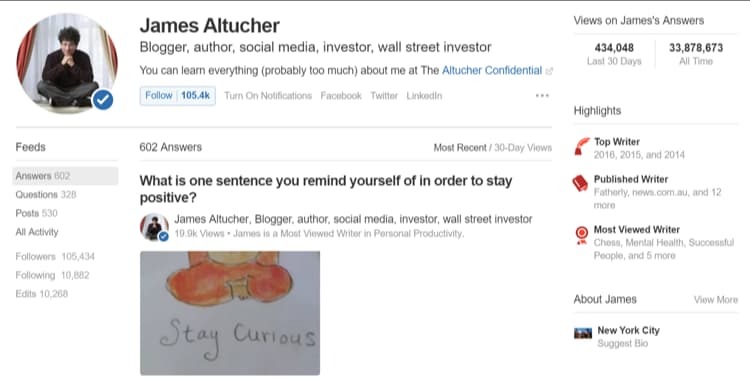
Quora as a Traffic Source on How to Grow Your Blog

Quora is a question and answer forum that allows anyone to respond to questions across a wide variety of topics and users. Unlike it’s somewhat deformed and red-headed cousin Yahoo Answers, Quora possesses a highly-moderated community that generally provide questions and answers of a much higher quality level compared to other similar sites.

A tactic that I’ve used successfully to grow my blog, is to find genuine questions that are relevant to my niche (blogging) and spend a meaningful amount of time delivering in-depth answers to those people.

Within my answer, I’ll typically add a call-to-action to a relevant blog post that I’ve published in the past, which is a great strategy to grow your blog with incremental referral traffic as you build a reputation.

By continuously posting well-researched answers on Quora, I’ve been able to build up my authority within my niche, as well as grow the authority for my blog.

2. Compile impactful expert roundups

Expert Roundups Strategy to Grow a Blog Traffic

For an easy way to create valuable content, network with influencers and grow your blog by boosting credibility and expertise at the same time—look no further than compiling expert roundup posts.

With an expert roundup post (like both my my compilation of the best blogging advice and the best business advice), what you’re essentially doing is crowdsourcing an article from a variety of influencers in your industry. By simply associating your own name with other authorities and influencers within your blog niche, you’re signaling to your audience that you also have similar levels of expertise.

While you can often compile an article by utilizing existing quotes found online, I like to send as many personalized cold emails as possible to key influencers when I’m writing a roundup post, so that I can include some fresh advice not found elsewhere.

Not only does this give your blog post extra credibility, but if you can get any of these influencers to share the post after it goes live, that’s a strong vehicle by which you can grow your blog.

As an alternative tactic to grow your blog, you can also make it well-known that you’d love to participate in other blogger’s roundup articles. Dive into your network. Find social groups with other bloggers and actively share your advice when others have questions.

With this approach, instead of laboring on a 5,000-word article, you can write a short (but still valuable) answer, and get mentioned alongside other big names within your niche.

3. Co-host webinars

Webinar use as a strategy to grow your blog

Another way to consistently grow your blog by getting in front of an engaged audience and demonstrating your expertise—is to co-host a webinar with a well-known brand, more established blogger or company in your industry.

Many brands and bloggers currently run webinars as a part of their content marketing strategy, and most of them are always looking for creative ways to bring more value to their audience by having an expert in to share valuable knowledge.

4. Get interviewed on podcasts

Podcast guesting to grow your blog quickly

This is a tactic I’ve used for several years as a way to grow my blog—and it’s always brought me great results.

Even if you don’t have your own podcast (like mine), that doesn’t mean you can’t still take advantage of both the growing popularity of podcasts and the need of podcast hosts to have on interesting guests.

There are more and more shows springing up every day, and all of them hungry to provide unique and valuable content for their audience. What that means for you, is that there is a practically endless number of opportunities for you to get interviewed by a podcast—provided, of course, that you have something worthwhile to say.

But don’t wait around for podcasts to notice you and your story. Get a head start on this strategy to grow your blog by reaching out to a handful of podcast hosts every week, and seeing who’d be interested in bringing you onto their show.

5. Launch a virtual summit

Make Money Blogging with Virtual Summits to Monetize Your Blog

While nothing beats the ability to connect and communicate with people face-to-face, that doesn’t mean you can’t achieve similar results (and grow your blog at the same time) through video interviews.

Virtual summits are fast becoming one of the most popular ways for influencers to network with other influencers in their space and get their brand in front of an engaged audience.

While hosting a virtual summit requires no small amount of work, it’s a tactic that can pay off hugely in the sheer amount of leads and exposure it can bring you. If you’re interested in learning how to host your own successful virtual summit as a vehicle for how to grow your blog, make sure to check out my step-by-step guide on how I created a virtual summit that reached over 20,000 people in just 60 days.

Comments

Popular posts from this blog

How to start a blog that makes you money Anyone can start a blog that makes money. Seriously. Some of you can even generate enough money from your blog to quit your job. Don’t believe me? My blog gets over 2,436,100 visitors annually and generates more than one million dollars in revenue. Screenshot of Neilpatel.com's transaction volume statistics. Above is an example of a 30-day earning period from a previous year. I earned over $381,000 in one month that year! While you’re probably not going to reach that amount right now, I can teach you how to start a blog that makes over $3,000 per month. I started from scratch just like you. But after more than a decade of trial and error, I’ve finally figured out the secret to running a successful blog that makes money. You can avoid these mistakes and generate profits much quicker by following the blueprint outlined in this guide. Your 2-Minute Quick Start Cheat Sheet Looking for a barebones, quick start guide to get started as fast as possible? In this section, we won’t cover everything, only the essential steps. Everything is covered in way more detail later, so jump down if you hit a snag. Before you begin, it’s important to understand the principles behind starting a blog. Pick a big enough niche. Make sure to pick a niche that is bigger than “vegan Caribbean recipes” but smaller than “nutrition.” Don’t stick with one platform. I know I’ve told you that you need to use WordPress as your blogging platform, but it shouldn’t stop there. Why not also use Medium, Tumblr, or even LinkedIn? Control your destiny. Post in multiple places and always link back to your site so you can better control traffic to your site. Blogging is both about “you” and “I.” People want to read stories. They want to be involved in a conversation, and the easiest way to do this is to use the words “you” and “I” within your blog posts. Always ask questions. At the end of every blog post, always ask a question. If you don’t ask a question, people won’t know what to do next. You have to stand out. You have to go above and beyond. Sadly, there is no single answer as every industry is different, but typically, infographics, visuals, and branching off from everyone else in your space will help you stand out. Your content needs to be portable and easy to digest. For example, creating video-based content or audio-based content (podcasts) are simple ways to make your content portable. Content isn’t king unless it’s good. Writing mediocre content isn’t good enough. It won’t do well, and you will just be wasting time. So, don’t write content unless it is really, really, really good. You have to produce quality and quantity. To increase your odds of success, you need to be willing to produce amazing content in quantity. Your blog isn’t always the best place to blog. From industry blogs to large sites like Entrepreneur and Business Insider, consider placing your best content on places with more visibility and higher domain authority, especially in the beginning. Useful content beats viral content. Instead of focusing on creating viral content (when you have less than a 1% chance of producing it), focus on creating useful content. Useful content tends to be evergreen, which means it can generate steady traffic over time. It’s easier to build a personal blog than a corporate one. People connect with people more than they connect with corporate brands. A blog won’t work without a community. Blogging is about creating conversations. But without readers and community, there is no conversation. No man is an island. Make sure you respond to each and every comment. Not just on your blog, but even when people comment on your social profiles, make sure you respond back. People don’t read; they skim, so write your content with that in mind. From leveraging headings to even writing a conclusion at the end of each post, this will help your readers get value out of your content even when they don’t fully read it. It’s all about the headline. 8 out of 10 people will read your headline, but only 2 out of 10 will click through and read the rest. So focus on creating amazing headlines, or else you won’t get tons of traffic. Reveal your cards, all of them. When making a point and having something to back it up, make sure you do it early on in each blog post. It is a great way to hook your readers and get them to read the rest of your content. Consistency will make or break you. Don’t start a blog unless you are willing to be consistent. Not just for a few months or a year, but I am talking years (3 plus). Don’t ever rely on 1 traffic channel. You need to have an omnichannel approach in which you are leveraging all of the feasible channels out there that work for your niche. Don’t forget about Google. You should always write for humans and not search engines. But that doesn’t mean you should ignore Google. Be sure to include keyword research from Ubersuggest and blend them into your content. Understand not all content is meant to last forever. As your blog gets older, your responsibilities will grow. One of them is the willingness to kill some of your content. Not all of your content will be relevant a year or two from now. You can’t set it and forget it. As your content gets outdated, you’ll want to keep it fresh, or people will find that it’s useless and bounce away. People won’t come back to your blog unless you ask them to. No matter how good your content is, people won’t just come back unless you ask them to. The easiest way to do this is through emails and push notifications. Don’t wait too long to monetize. If you go years before trying to monetize, people will assume everything on your blog is free. Have multiple monetization strategies. Not only is it a safer strategy to have multiple monetization methods, but you’ll also make more money. Be willing to pay the price. If you want to succeed, you have to be willing to put in the time and energy. And if you can’t, then you have to be willing to put in money. If you don’t. then you won’t do well, no matter how brilliant of a writer or marketer you are. Now that you know the jist for starting a blog, it’s time to break it down into actionable steps so you can be on your way to making money. Here are the next steps to take: Unleash Ideas Within You Choose a Name For Your New Blog Get Web Hosting From Hostinger Get Familiar With WordPress Install a WordPress Theme Customize Your Blog Brainstorm Blog Topics Write Your First Masterpiece Create an Editorial Calendar Monetize Your Blog Step 1. Unleash Ideas Within You Stop. Don’t get overwhelmed about this whole thing. Just breathe. You got this. You don’t need to reinvent blogging to be successful. You just need to be specific about what you want to talk about. The best way to do that is to get inspired by someone you admire in the same niche or industry. Do they have a blog? If yes, read it. Then begin to let your ideas form. If you have no one specific, find someone you admire. Then let the ideas form. Take your unique experiences and speak about them in your voice. Use your vocabulary and personality, and don’t think about it too much. Let it flow. Your tribe will follow if you stay consistent. When it comes to choosing your blog’s niche, there are two key questions to ask yourself. 1. Do I Enjoy Learning About This Topic?